

Introduction
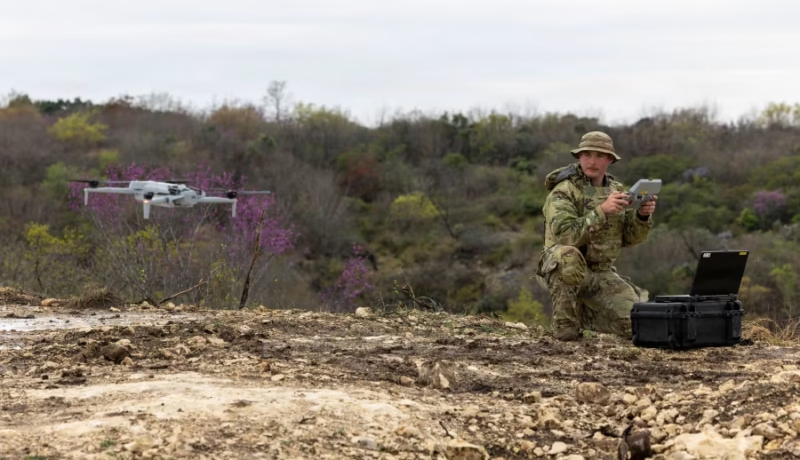
The relationship between drones and artificial intelligence (AI) is becoming one of the most important technological shifts of 2026. While many people still see drones as either hobby gadgets or delivery tools, the reality is very different. Modern drones are now a core data source for AI systems, and in return, AI is making drones smarter, more autonomous, and more valuable.
Table Of Content
- Introduction
- 🎥 Skydio X10D in Action
- Why AI Needs Drones (Data is Everything)
- 📌 Why drones are better
- 🟢 How AI Uses Drone Data
- 📌 What “quality” means has changed
- 🟢 Digital Twins: The Most Powerful AI + Drone Use Case
- 📌 Real-world use cases
- 🟢 How AI is Changing Drone Technology
- Key improvements include
- 🟢 What This Means for the Drone Industry
- Key industry shifts
- 🟢 Final Insight
🎥 Skydio X10D in Action
Before understanding the full impact of the Skydio X10D Army order, it’s important to see how this drone performs in real-world scenarios. This video shows its flight capabilities and AI-powered navigation in action.
This demonstration helps explain why drones like the X10D are becoming critical in modern military operations.
This evolving connection is especially important in industries like construction, agriculture, energy, and surveillance — where accurate real-world data is essential for decision-making.
If you are following the drone industry closely, especially developments like the Skydio X10D Army order, you’ll notice that AI integration is now a key driver in both military and commercial drone adoption.

Why AI Needs Drones (Data is Everything)
AI systems that operate in the physical world require large-scale, high-quality, and consistent data to function properly.
For example:
- A roof inspection AI must analyze thousands of roof conditions
- Solar monitoring systems need thermal imaging over time
- Construction AI requires repeatable site scans with exact GPS accuracy
Traditional methods like satellites, helicopters, or manual inspections are either:
- Too expensive
- Too slow
- Or too low-resolution

📌 Why drones are better
Drones solve this gap by providing:
- High-resolution imagery
- Repeatable flight paths
- Controlled altitude capture
- Cost-effective deployment
This makes drones one of the most reliable data collection tools for AI training systems.
👉 For example, companies like FlyGuys have delivered millions of images per month to AI systems for infrastructure analysis.
🟢 How AI Uses Drone Data
Earlier, drone pilots were expected to both:
- Capture data
- And analyze results
But now AI has completely changed this workflow.
Today, companies prefer:
👉 Raw drone data instead of processed results
Why?
Because AI platforms want:
- Full control over analysis
- Custom model training
- Large datasets for learning patterns
📌 What “quality” means has changed
Before (photography focus):
- Lighting
- Cinematic shots
- Smooth video
Now (AI data focus):
- Correct altitude
- GPS accuracy
- Frame overlap
- Sensor consistency
- Structured data formats
👉 This shift is turning drone pilots into data providers, not just photographers
🟢 Digital Twins: The Most Powerful AI + Drone Use Case
One of the most important applications of drones and AI is the development of digital twins.
A digital twin is a 3D virtual replica of real-world objects or environments, built using drone imagery, LiDAR, and mapping data.
📌 Real-world use cases:
- Construction progress tracking
- Virtual building inspections
- Industrial facility monitoring
- Energy infrastructure management
Instead of physically visiting sites, companies can now:
👉 Walk through digital environments
👉 Detect errors early
👉 Reduce costs and risks
This is only possible because drones can continuously collect accurate, georeferenced data.
🟢 How AI is Changing Drone Technology
The integration of AI is also transforming drone hardware itself.
Key improvements include:
- AI-powered obstacle avoidance
- Real-time hazard detection
- Smarter flight path decisions
- Advanced cameras
- Thermal sensors
- Multispectral imaging
- LiDAR integration
- Smarter flight systems
- Automated mapping
- Optimized data collection routes
These upgrades are making drones more useful not just for photography, but for industrial-scale intelligence gathering.
👉 This same evolution is visible in modern systems like the Skydio X10D Army order, where AI-driven navigation is a core feature.
🟢 What This Means for the Drone Industry
The convergence of drones and AI is reshaping the entire drone industry.
Key industry shifts:
- Drone pilots becoming data specialists
- Increased demand for consistent aerial data collection
- Growth in enterprise and industrial drone services
- AI-driven automation replacing manual analysis
This means the most successful drone operators in the future will not just be photographers — they will be reliable data providers feeding AI systems at scale.
📌 Related reading:
- https://hitnbuy.com/best-drones-for-beginners/
- https://hitnbuy.com/drones-for-videos-and-photos/
- https://hitnbuy.com/drones-with-long-battery-life/
🟢 Final Insight
The connection between drones and AI is not optional — it is foundational.
Drones provide the physical world data that AI needs to learn, while AI makes drones smarter, more autonomous, and more scalable.
As seen in recent military developments like the Skydio X10D Army order, this partnership is not just shaping commercial industries — it is redefining modern defense, infrastructure, and automation systems.



No Comment! Be the first one.